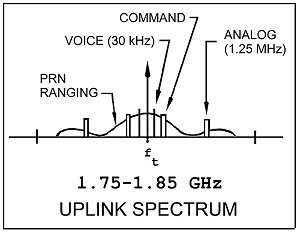
From a satellite communications course that I went to and from a IEEE publication on Shuttle communications we know that the present-day SGLS uses S-band for up- and down-links, but that the uplink band is different from that of NASA and all other Western space agencies.
|
UPLINK |
|
| Frequencies, FreqUp | 1763.721-1839.795 MHz, 20 channels 4004 kHz spacing |
| Function 1 | PRN ranging |
| Function 2 | Voice 30 kHz |
| Function 3 | Command FSK/AM 95,76, 65 kHz tones at 1 or 2 kbps |
| Function 4 | Analog 1.25 MHz subcarrier |
|
DOWNLINK |
|
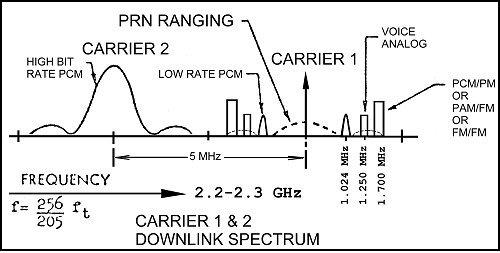
| FreqDown = | FreqUp * 256/205(1+2V/C) = 2202.50-2297.500 MHz, 20 channels, 5000 kHz spacing |
| Carrier 1 | PRN ranging, 1.024 MHz (PSK, PI/2), 1.2500 MHz voice, 1.700(PSK, FM/FM) PCM/PM. PAM/FM or FM/FM |
| Carrier 2 | High bit-rate PCM, 5 MHz below carrier 1 |
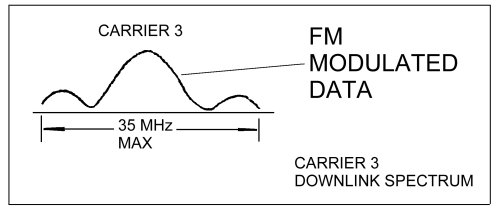
| Carrier 3 | FM modulated data, 35 MHz maximum bandwidth |
Carrier 3 is very interesting. The wideband FM signal seems to be an image link of some sort.
Specifically for the Shuttle the frequency bands have been divided as follows:
| Uplink | Low band | 1763-1804 MHz |
| High band | 1803-1840 MHz | |
| Downlink | Low receive | 2200-2253 MHz |
| High receive | 2251-2301 MHz |

